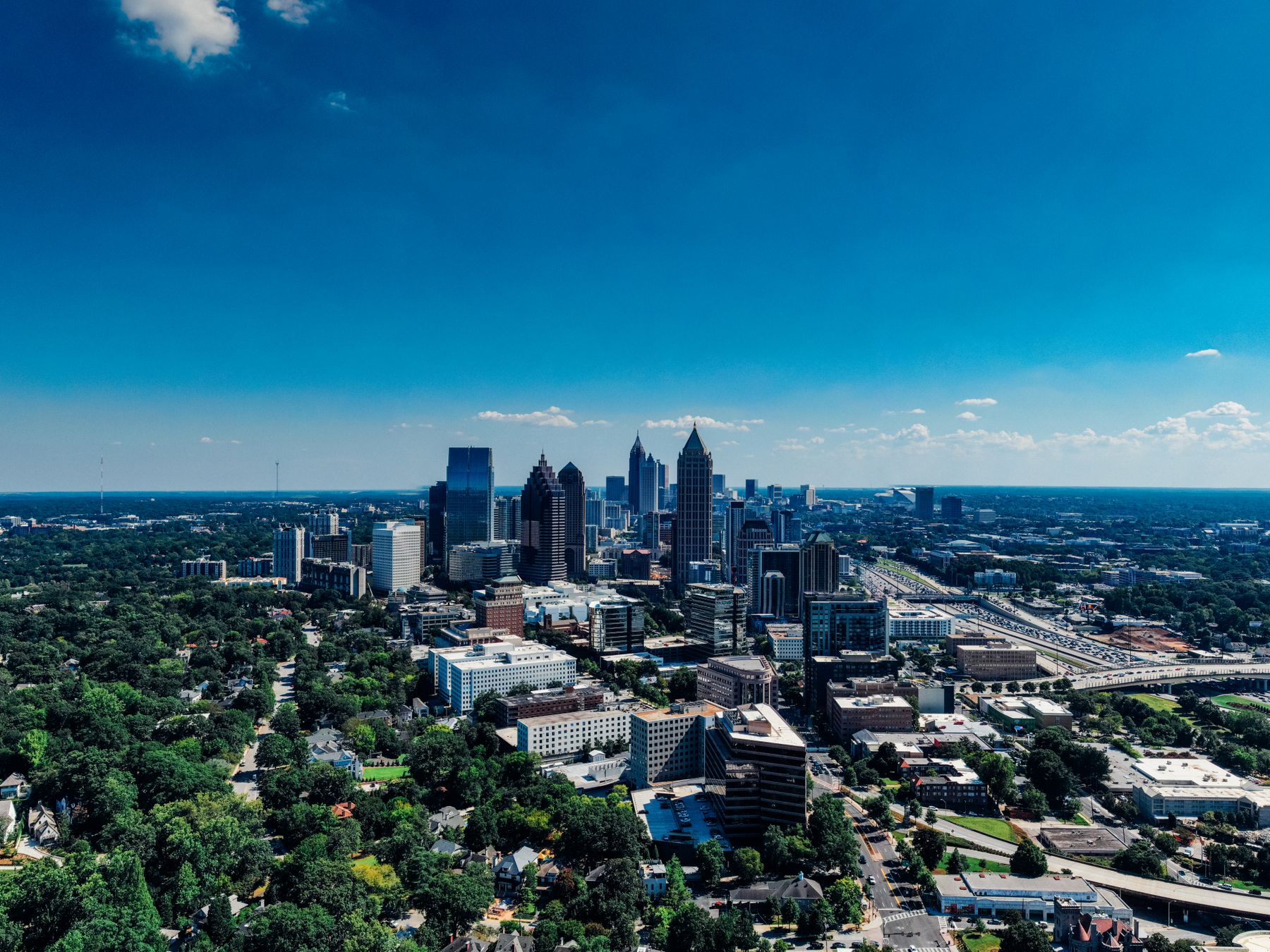

Begin at Peachtree Center MARTA station, where you surface into a dense cluster of connected towers from the 1960s and 1970s. John Portman's Hyatt Regency Atlanta (1967) is the one interior to go out of your way for, with its concrete atrium and the blue-domed Polaris restaurant now back in service after years of closure. Entry is free, but it is a working hotel, so keep your visit short and quiet. Ten minutes east, the Georgia State Capitol (1889), designed by Willoughby J. Edbrooke, sits under a gold-leaf dome and is open to the public on weekdays for self-guided walks through the halls.
Start in Downtown: Modern Towers and One Essential Interior
Begin at Peachtree Center MARTA station, where you surface into a dense cluster of connected towers from the 1960s and 1970s. John Portman's Hyatt Regency Atlanta (1967) is the one interior to go out of your way for, with its concrete atrium and the blue-domed Polaris restaurant now back in service after years of closure. Entry is free, but it is a working hotel, so keep your visit short and quiet. Ten minutes east, the Georgia State Capitol (1889), designed by Willoughby J. Edbrooke, sits under a gold-leaf dome and is open to the public on weekdays for self-guided walks through the halls.
Walk west along Martin Luther King Jr. Drive toward the Omni and the CNN Center, where the 1970s atrium and escalators are worth a fifteen-minute detour. Then loop north into the Fairlie-Poplar district, roughly between Peachtree Street, Marietta Street, Broad Street and Luckie Street. This is the largest remaining collection of early-20th-century commercial buildings in the city, mostly 1890s to 1930s commercial blocks, now used as offices, lofts and a handful of coffee shops. The district is a short walk from Peachtree Center and Five Points stations, and it rewards slow looking rather than a checklist. Read plaques where they exist; many buildings have none, so bring a phone with a map.
Fairlie-Poplar and the Old Fourth Ward: Where the Texture Is
Fairlie-Poplar is best walked on weekdays between 9am and 5pm, when the streets have office workers and the storefronts are open. Look up: the Healey Building (1913) on Forsyth Street has a terracotta facade and a small, free lobby worth a peek. The Flatiron Building on Marietta Street is a wedge-shaped 1897 office block, and the Candler Building on Peachtree Street is a 1906 beaux-arts tower with lobby detail that still reads as commercial ambition. Most of these buildings are not open beyond their lobbies, so plan an hour to ninety minutes and do not expect tours. The district borders the Five Points MARTA station, which makes it an easy stop between Downtown and the Old Fourth Ward.
For contrast, walk or ride two stops east to the Martin Luther King Jr. National Historical Park in the Old Fourth Ward. The visitor center and the surrounding buildings, including the King birth home, are managed by the National Park Service and are free to enter. The architecture here is modest residential and church stock, not monumental, and the experience is about the neighborhood, not the buildings. Nearby, the Sweet Auburn Curb Market on Edgewood Avenue is a 1924 municipal market building and a good lunch stop. Allow half a day for this section, or skip it if your time in Atlanta is short and you want the city's densest architecture.
Midtown: Arts Center, Peachtree Street and the High Museum
Midtown holds the contemporary work most architects come for. The High Museum of Art on Peachtree Street is Richard Meier's 1983 white clapboard-and-glass building, expanded by Renzo Piano in 2005. Go on a weekday morning for the best light and fewer people. A fifteen-minute walk north along Peachtree Street takes you to the Museum of Design Atlanta, a small design-focused museum that is quick but worthwhile for mid-century and contemporary design exhibitions. Around the Arts Center MARTA station, One Atlantic Center (1987), designed by Johnson/Burgee, is a worthwhile exterior stop with its pink granite and bronze detailing.
Walk south from Arts Center along Peachtree Street toward the Fox Theatre at Ponce de Leon Avenue, a 1929 movie palace with Moorish and Egyptian-inspired detail that is visible from the street even when the venue is closed. Continue south toward the Federal Reserve Bank of Atlanta and the Woodruff Arts Center, which anchors the strip. Midtown is walkable and easy to reach by MARTA; allow three to four hours for this section and do it on foot rather than driving. Skip the area at night if you are walking alone or unfamiliar with the city. If you want to be close to this stretch, a hotel within a fifteen-minute walk of the Arts Center or Midtown stations will save you two days of transit.
Where to Base Yourself and What to Skip
For this walk, stay Downtown near Peachtree Center if you want the historic districts first, or Midtown near Arts Center if you prefer the High Museum and Peachtree Street. Downtown hotels sit within a five-to-ten-minute walk of the Fairlie-Poplar district and the Peachtree Center MARTA station, which connects to the airport in about twenty minutes. Midtown puts you within walking distance of the High Museum and the museum district, with frequent bus and rail service. Both are safe for daytime walking in the tourist core; keep to lit streets after dark and use rideshares for night returns. Book directly with the hotel or through a booking partner, and check whether breakfast is included before you commit.
Skip the Atlanta BeltLine on a short architecture trip unless you have a specific design interest; the Eastside Trail is more about landscape and street art than buildings. Skip the Georgia World Congress Center area unless an event takes you there; it is convention architecture with little to see on foot. Best months for this walk are October through November and March through April, when temperatures sit in the 60s and 70s Fahrenheit and humidity is low. Summer afternoons are humid and storms arrive quickly, so start before 9am if you walk in June, July or August. Do not try to cover Downtown and Midtown on foot in one day; use MARTA once between them.
"Atlanta for Architecture Lovers: A Walking Route Through Downtown and Midtown" was written by the people who run AirFair Atlanta and is published as they wrote it, in November 2026. It is in 4 parts: Start in Downtown: Modern Towers and One Essential Interior, Fairlie-Poplar and the Old Fourth Ward: Where the Texture Is, Midtown: Arts Center, Peachtree Street and the High Museum and Where to Base Yourself and What to Skip.
Read the method ↗